
From LEGO to Real Robots: How Hands-On Robotics Helps Kids Ages 5–18 Build Skills for the Future
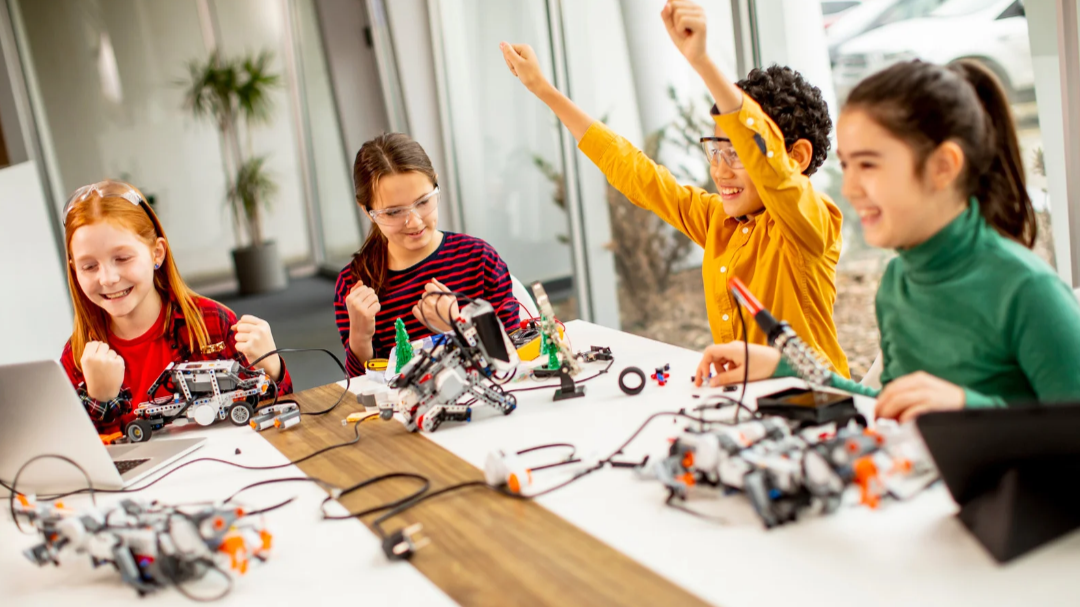
Robotics isn't just about building machines. It's about building creative thinkers, confident problem-solvers, and future innovators.
Imagine a five-year-old proudly watching a robot move for the first time after putting together a few LEGO pieces. Now imagine that same child, years later, designing a competition robot using professional CAD software, programming it in Java, and working with teammates to solve complex engineering challenges.
At Penguin Coding School, we believe that robotics offers one of the most exciting ways for children to develop skills that will serve them throughout their lives. Our hands-on robotics programs grow with students, beginning with playful LEGO-based exploration for ages 5–8, progressing to LEGO robotics competitions for ages 9–12, and culminating in advanced FIRST Tech Challenge (FTC) robotics for students ages 12–18.
Along the way, students learn much more than coding and engineering. They develop creativity, perseverance, teamwork, leadership, and the confidence to tackle challenges they once thought were impossible.
Why Hands-On Robotics Is So Valuable for Children
Children learn best when they are actively engaged in discovering how things work. Robotics brings together science, technology, engineering, and mathematics (STEM) in a way that is tangible, interactive, and fun.
Unlike learning concepts solely from a textbook or computer screen, robotics gives students the opportunity to turn their ideas into something physical. They can build a machine, program it to move, observe what happens, and make improvements.
This process teaches several essential life skills:
Problem-solving: Students learn to break complicated challenges into manageable steps.
Creativity: There is rarely just one solution to an engineering problem, encouraging students to experiment with different ideas.
Perseverance: Robots don't always work the first time. Students learn that mistakes are opportunities to improve.
Teamwork: Students collaborate, communicate, and combine their strengths to achieve shared goals.
Critical thinking: Students test their assumptions, analyze results, and make decisions based on evidence.
Perhaps most importantly, robotics helps children develop a growth mindset, the belief that their abilities can improve through effort, practice, and learning.
Ages 5–8: Discovering Robotics Through LEGO and Play
The first step in a lifelong engineering journey begins with curiosity.
For our youngest students, robotics is about exploration, imagination, and the excitement of making something move.
At Penguin Coding School, children ages 5–8 participate in hands-on robotics classes using age-appropriate LEGO robotics kits. Students build models with motors, sensors, gears, and other mechanical components while learning introductory programming concepts.
Rather than simply following instructions, children are encouraged to ask questions: What happens if we change the gears? How can we make our robot move faster? Can we program it to react to an obstacle?
These playful experiments introduce fundamental engineering principles without making them feel like formal lessons.
What Young Children Learn
Mechanical engineering fundamentals: Building with LEGO helps children understand gears, wheels, axles, motors, and how different parts work together.
Early coding concepts: Through visual programming, students learn sequencing, loops, and cause-and-effect relationships.
Spatial reasoning: Assembling three-dimensional structures strengthens children's ability to visualize how objects fit together.
Confidence and independence: Successfully building and programming a robot gives children a tremendous sense of accomplishment.
For a six-year-old, watching a robot follow their instructions can be magical. But behind that excitement, they're developing the foundations of computational thinking and engineering.
And because they're having fun, they often don't realize how much they're learning.
Ages 9–12: Taking Robotics to the Next Level with LEGO Competitions
As children grow, robotics evolves from individual exploration into collaborative engineering challenges.
Starting around age nine, students at Penguin Coding School can join our competitive LEGO robotics teams, participating in the FIRST LEGO League (FLL) program.
FLL introduces students to a new dimension of robotics: designing, building, and programming robots to accomplish specific missions on a competition field.
Students use LEGO robotics technology to create autonomous robots that navigate obstacles, manipulate objects, and complete challenges—all within a limited amount of time.
But the competition is about much more than the robot itself.
Learning to Think Like Engineers
FLL teams experience an authentic engineering design process. They brainstorm solutions, build prototypes, write programs, test their robots, and refine their designs based on performance.
A robot might successfully complete a mission during practice but fail during competition. Students must figure out why, make adjustments, and try again.
This teaches an important lesson: engineering success rarely comes from getting everything right the first time. It comes from continuously improving.
Building Teamwork and Leadership
In competition robotics, students learn to work as a team toward a common goal.
Some students may gravitate toward mechanical design, while others enjoy programming, strategy, or presenting their ideas. Over time, they discover their individual strengths while learning to appreciate the contributions of their teammates.
FLL also challenges students to research real-world problems, develop innovative solutions, and communicate their findings.
These experiences build public speaking skills, leadership, collaboration, and the ability to explain technical ideas clearly.
For many students, participating in a robotics competition is their first experience working on a long-term engineering project with a team—and one of their most memorable learning experiences.
Ages 12–18: Real-World Engineering with FIRST Tech Challenge
For middle and high school students ready for a greater challenge, robotics becomes remarkably close to real-world engineering.
Penguin Coding School's FIRST Tech Challenge (FTC) teams take students beyond LEGO robotics and introduce them to sophisticated robots built with metal components, motors, sensors, and advanced control systems.
These are not simple classroom projects. Students design, manufacture, assemble, and program competition robots capable of performing complex tasks autonomously and under driver control.
FTC offers a powerful introduction to the tools and practices used by professional engineers.
Java Programming: From Code to Physical Action
Students learn to program their robots using Java, a widely used professional programming language.
Unlike introductory block-based coding, Java allows students to develop increasingly sophisticated robot control systems.
Students write programs to control motors, read sensor data, navigate the competition field, and automate complex sequences of movements.
They begin to understand how software interacts with hardware—a foundational concept in robotics, automation, and computer engineering.
For students interested in computer science, FTC provides an especially compelling reason to learn programming: the code they write directly controls a real machine.
CAD Design: Turning Ideas into Engineered Parts
FTC students also learn computer-aided design (CAD), using professional-style 3D modeling tools to design robot components and mechanical systems.
Instead of relying exclusively on prefabricated parts, students can design custom components tailored to their robot's needs.
They learn to consider dimensions, mechanical fit, material selection, and how different components interact.
Students may also gain experience with manufacturing tools such as 3D printers and CNC machines, turning digital designs into physical parts.
This connection between digital design and physical manufacturing helps students understand how real products are engineered.
Advanced Mechanical Engineering
FTC robots introduce students to more sophisticated engineering challenges involving motors, gear ratios, torque, drivetrains, structural design, and mechanical mechanisms.
Students must balance competing priorities: speed versus precision, strength versus weight, complexity versus reliability.
There is no single perfect robot design. Every engineering decision involves trade-offs.
Through repeated testing and redesign, students develop the analytical skills needed to evaluate these trade-offs and improve performance.
Preparing for College and Beyond
FTC offers valuable experiences for students considering future studies in mechanical engineering, computer science, electrical engineering, robotics, or related fields.
Students can develop practical experience with programming, CAD, prototyping, project management, and technical communication.
Just as importantly, they learn to work on complex projects over many months, manage deadlines, collaborate with peers, and remain resilient when designs fail.
These experiences can help students discover their academic interests long before they choose a college major.
A Continuous Robotics Journey: From Age 5 to 18
One of the unique advantages of Penguin Coding School is that students can continue developing their robotics skills as they grow:
Ages 5–8:
LEGO Robotics Classes
Creative building, basic coding, motors, sensors, and problem-solving
Ages 9–12:
FIRST LEGO League Teams
Autonomous robotics, engineering design, teamwork, and competitions
Ages 12-18:
FIRST Tech Challenge Teams
Java programming, CAD, mechanical engineering, and advanced robotics
Each stage builds upon the previous one.
A child who learns basic programming sequences at age six may later write autonomous navigation programs in Java. A student who experiments with LEGO gears at age seven may eventually design sophisticated mechanical systems using CAD.
The tools become more advanced, but the fundamental approach remains the same: imagine, build, test, learn, and improve.
Robotics Is About More Than Preparing Future Engineers
Not every child who participates in robotics will become an engineer—and that's perfectly fine.
The benefits of robotics extend far beyond STEM careers.
A future doctor benefits from analytical thinking. An entrepreneur needs creativity and perseverance. A business leader must know how to collaborate with people who have different skills and perspectives.
Robotics helps develop all these abilities.
It also gives students something increasingly valuable in a technology-driven world: the confidence to be creators of technology, rather than simply consumers of it.
Instead of only playing with gadgets, they learn how gadgets work. Instead of simply using software, they learn to write it. Instead of wondering how machines are built, they gain the skills to design their own.
Start Your Child's Robotics Journey at Penguin Coding School
Whether your child is five years old and fascinated by LEGO or a teenager interested in advanced engineering and programming, Penguin Coding School offers a pathway to explore robotics at every stage.
Our programs combine hands-on learning, creative problem-solving, and age-appropriate challenges to help students grow from curious beginners into confident young innovators.
From their first moving LEGO creation to a fully programmed FTC competition robot, every milestone represents more than a technical achievement. It represents new skills, greater confidence, and a deeper understanding of what's possible.
The next generation of engineers, inventors, and innovators starts somewhere. Why not with their very first robot?
Explore robotics classes and competition teams at Penguin Coding School and help your child start building their future today.
